

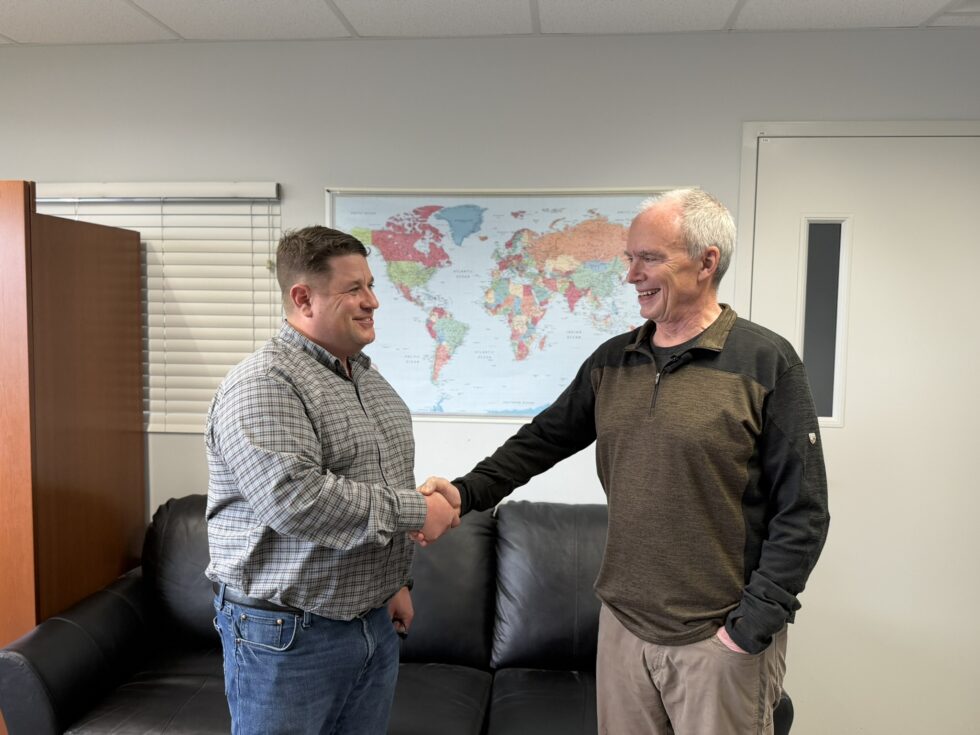
When you drive past some of the quiet, nondescript industrial buildings just south of US 10 in Ludington, you might never guess what is happening inside. There are no flashing neon signs, no hint of ties to some of the biggest names in the automotive industry. But behind the plain walls of three of the buildings lies a universe of heavy-duty automation, cutting-edge engineering, and advanced robotics that connects rural Mason County to the global automotive stage.
This is UACJ Automotive Whitehall Industries. Just ahead of a major leadership transition — as longtime CEO David Cooper retires and passes the torch to incoming President and CEO Mike Wegener — Whitehall Industries is reinforcing its commitment to residents of Mason County by establishing the UACJ Automotive Whitehall Industries Community Fund at the Community Foundation for Mason County.
This fund marks a shift from multiple short-term donations to local organizations over the years to a sustainable engine for long-term community support.
To understand the impact of the new community fund, you first have to understand the scale of what this manufacturer actually does. It is likely far bigger and more sophisticated than most people realize.
As a key subsidiary of the Tokyo-headquartered corporate giant UACJ (United Aluminum Company of Japan), Whitehall Industries is a major player in the global automotive supply chain.
The facility takes what Cooper calls “the log” — a massive, 20-foot-long, 10-inch-diameter bar of solid aluminum — and heats it and pushes it through a heat-treated steel die using up to 10 million pounds of force.
“It’s like a Play-Doh factory,” Cooper said, revealing a bit of his engineer wit. “Except they’re not stars and moons. But that’s the same idea.”
What actually extrudes from that intense process are highly sophisticated, hollow aluminum components that are then bent, machined, and robotically welded for global automotive giants. For anyone driving a Tesla, a Jeep, a General Motors vehicle or a Honda, there is a good chance a critical piece of that vehicle was built right here in Mason County.
Manufacturing at this level comes with a profound daily responsibility, as Whitehall primarily produces safety-critical components like vehicle bumper beams and transmission supports. When a vehicle crashes, the aluminum cannot act like rigid steel and transfer the violent impact directly to the passengers; it must behave exactly as the engineers intended.
To guarantee it flexes, bends and absorbs the precise amount of crash energy needed to protect human life, Whitehall tests its components under massive presses that literally crush the aluminum.
The gravity of this work is felt across the entire manufacturing floor.
“When you think about that bumper, you do feel a responsibility for that,” Cooper said. “And it’s more reason to follow procedures and have processes designed so that it’s easy to do it right and hard to make a mistake.”
Whitehall holds a solid reputation because of its commitment to safety and precision. The company recently achieved a historic milestone, taking home the prestigious Honda Quality and Delivery Award for the second consecutive year. Out of every single Honda supplier across North America — spanning Canada, the U.S. and Mexico — Whitehall was the only company to win it twice in a row, thanks to a flawless record of zero defects and zero missed deliveries. On top of that, General Motors has honored Whitehall with quality awards for 14 consecutive years, recognizing a perfect quality streak for a specialized luggage compartment component.
Despite these major industry accolades, the company’s internal culture remains down-to-earth. Part of that stems from UACJ’s corporate philosophy of integrity and honesty, which aligns closely with Whitehall’s emphasis on workplace equality. Even with a team of roughly 900 people, everyone is treated on the same level.
“We have a culture where everybody is sort of equal,” Cooper explained. “Whether you’re the president or the machine operator, we’re all people with different jobs. We have that mutual respect.”
And as for their low corporate profile? Cooper grinned and summed it up like this:
“We’re all very technical people too. We’re all engineers. And geeks. We really are.”
As Cooper wraps up his 45-year engineering career and prepares to go cross-country camping with his wife, Sarah, he leaves behind a framework that ensures the community continues to benefit from Whitehall’s success.
The company’s most visible local investment is the FIRST Robotics Practice Facility, which opened inside its plant’s footprint in 2025. Championed by the MiSTEM Network and co-funded by UACJ Automotive Whitehall Industries and other caring partners — including the Community Foundation — the arena gives students hands-on experience with the same technology that powers multi-million-dollar factories. This past year alone, 468 students from 12 area schools utilized the space.
The goal isn’t just to give kids a fun hobby. The facility serves a deeper purpose: to show local youth that world-class, high-paying tech careers are waiting right here at home. As Mike Wegener shared at the grand opening, UACJ Automotive Whitehall Industries hopes to “grow engineers locally to keep them local.”
Similarly, the UACJ Automotive Whitehall Industries Community Fund makes sure that neighbors have access to resources they need to thrive. Cooper looks forward to seeing the community fund address some of the causes dear to his own heart, including food insecurity, housing, shelter for the homeless, and assistance for disadvantaged youth.
Leading Whitehall Industries and shepherding its impact now falls to incoming President and CEO Mike Wegener. At a time when many companies hire their leaders from the outside, Wegener is proof of Whitehall’s commitment to growing its own talent. He started at the company straight out of school 24 years ago and worked his way up to the highest position.
“My ultimate goal is just wanting to help the next generation be successful here,” Cooper said, reflecting on his own legacy, the legacy of the company he leaves behind, and that of his successor.
That goal is already taking shape.
With a permanent fund at the Community Foundation actively growing and local talent steering the ship, Whitehall Industries proves that a small rural community can compete on the global automotive landscape while also taking care of its own.